Mission Trip
September 27
As a Youth Minister, I had a complicated relationship with short-term mission trips. Christian comedian John Crist’s video “Honest Mission Trip Leader” parodied a certain era and type of mission trip. He articulated in 90 seconds some of my concerns that felt unspeakable at the time. In that same era, Christianity Today ran a cover story, “Don’t Paint the Orphanage.” My inner misgivings were now out in the wild, in the mouths of others. I forwarded the article and showed the video before a mission planning meeting. I’m okay with saying the hard part out loud, but some of those truths were still hard pills to swallow at the time.
There are labels we rarely question: “charity, missions, children, evangelism, service.” Questioning acts protected by those labels seems tantamount to ecclesiastical treason. It’s not. Outcomes matter. Vibes and good intentions are not reasons to dismiss discernment.
Well, we are planning a short-term mission trip. So I rewatched John Crist. I skimmed over the now 8-year-old article. I reminded myself that not all activity is necessarily positivity. Some charity is toxic. Some ministries are ineffective. And some short-term mission trips are barely more than tourism. And non-anxiously telling the truth about it is always a net good.
The Spring Break Mission Trip is “in the works.” We humbly ask that you help support it in prayer and by attending and contributing to the Fish Fry on Wednesday night. I can’t guarantee unmitigated success. I can tell you that many of us are working hard to be relational, to be effective, and to be faithful. I hope you partner with us.
-Lance Havens
Prayer
September 20
Many thinkers have reminded us of the tension between prayer and work. The basic teaching is this: Some pray for the work of the church. Others realize that prayer is the work of the church.
I’m an American. I was raised by farmers and ranchers. I think the answer to most problems is elbow grease and long days.
And yet…I am united with Christ. The one whose yoke is easy and whose burden is light. The one who prioritized prayer early in the morning and late at night. The one who, when he saw hungry crowds, didn’t grab a plow but gave thanks to God for the meager gift that had been offered and watched it multiply beyond the need.
And yet, there were long days of ministering to the crowds. Jesus was fully human. He got tired. He got sad. Fatigue set in. It’s easy to imagine him levitating through life breezily on “God mode,” solving every problem with a wave of his hand, exercising sovereign control. And yet, we know he emptied himself of such privilege. The gritty pages of the Gospels show us a Savior who lived as a real human being, entirely dependent upon God the Father in every moment, even in the miraculous.
Which brings me to my point: It’s a false dichotomy to choose between work and prayer. Jesus models both.
AACC just hosted a prayer vigil. I wish I could put on a spreadsheet how many hours of ministry that equals. Kingdom math defies such analysis. Prayer is not a single act before the real work. Prayer is the work that fuels and multiplies our efforts and echoes into eternity.
-Lance Havens
9/11 and Formation
September 13
Friday marked the 25th anniversary of the 9/11 attacks. Evil was manifested for all to see. But so were bravery, courage, sacrifice, and love. Author Andrew Klavan makes this point: “Getting it wrong is evidence that we [humans] can also get it right.” We don’t know when the hijackers and planners of 9/11 began “getting it wrong,” but we know it was not a spontaneous decision. They had been malformed by a demonic ideology that shaped them into agents of malice.
But there were spur-of-the-moment heroes that day, too. Some ran into collapsing buildings. Others led co-workers out to safety. Some paid the ultimate price so that others could live.
Those moments did not come out of nowhere either. Long before that awful morning, character formation was happening. The hijackers were being malformed by a jihadist death cult. The heroes were being formed by love, loyalty, faith, family, and thousands of seemingly ordinary choices. All of us are constantly undergoing character formation. Our habits and influences are shaping us into someone. None of that is neutral. It affects whether, when the moment comes, we “get it right” or “get it wrong.”
The ministry application is simple. Intentionally shaping our habits (spiritual disciplines) and intentionally sharing life with others (discipleship) are formational. Today is our Life Group launch. We just finished a prayer vigil. These ministries are not activities to fill a church calendar. They are practices meant to shape us. We form our habits, then our habits form us.
We want to become people who, by plan or in the moment, “get it right.” We want to be workers who need not be ashamed.
We want to become like our Rabbi, Jesus.
-Lance Havens
Fall Surge
September 6
In ministry circles, summer can be a bit of a “slump.” Our members travel, and our Youth and Children’s ministries really amp up, but many of our other ministries slow down.
Well, it’s Labor Day weekend, and I am declaring the Fall Surge.
As the outdoor heat (hopefully) wanes, our ministries are switching into high gear. Here are a few opportunities to share life with one another, encounter God at a deeper level, or simply serve others.
Wednesday Meals restarted last week. Each Wednesday, we gather at 6:00 p.m. for table fellowship before our devotional and classes.
Adult Bible Classes — This Sunday marks the beginning of a new quarter for our adult classes. Find a place to love God with your mind, dig into Scripture, and be renewed.
The following opportunities have sign-up sheets in the Church Connection Center in the Main Foyer:
Raise Up Prayer Vigil — September 11 & 12
We pray in one-hour blocks over specific prayer requests from our students. This is a powerful opportunity both to spend time in the presence of God and to practice intercessory prayer on behalf of our students.
Football & Fireworks — September 12
HPU is inviting church groups to attend a special football game. Participating churches will be recognized during the evening, and the night will conclude with a fireworks display.
Life Groups — Beginning September 13
Life Groups are an opportunity to plug in, share life with one another, and experience transformation as we practice the way of Jesus together.
Fall is here. Find a place to plug in and feel the surge.
-Lance Havens
Raise Up Prayer Vigil
August 30
“Wait, you have something more important than our kids?”
The words may have fallen out of mouth in a moment, but as I reflected on it later it was both barbed and well-aimed. I stand by it. Ministry to our young people is not just a priority in my mind, it’s a sacred burden that is worthy of our highest efforts. And I know you feel the same way. I feel like John in his third epistle when he states that he has “no greater joy than to hear that [his] children are walking in the truth.” I also think a lot about Timothy, a protégé of Paul’s. Timid, by nature with a Greek father and taught the truth by two women, he probably didn’t seem like too much of a preaching prospect. Yet, there existed this flame to be fanned. It didn’t “take a village” for Timothy to become a pivotal leader in the young church. It took a faithful family and the church. My wish for every young person is just that. Education, financial inheritance, high I.Q, gifted off the charts, blah, blah, blah. Give me a faithful family and a church any day over anything else for any young person.
Which brings me to our Raise Up Prayer Vigil that will be hosted on September 11th and 12th from noon-8:00 PM each day. Sign up in the Main Foyer on the Church Connection Center. Pray over our Students’ prayer cards. Pray they have the flame of faith. Pray that flame is fanned. Pray that they know Christ and Him Crucified.
For our young people, I can think of few things more worthy of an hour our time.
-Lance Havens
Life Groups
August 23
Beliefism (believing the right things), churchianity (attending the right church), and a host of other -isms and -ianities can be seductive. I’ve dabbled in many of them. What I have found is that it doesn’t really matter whether it’s emotionalism (from the heart) or rationalism (from the head); they can all become distractions from authentic faith.
Christ’s call is to more than a set of propositions or even Bible knowledge. The cost is far higher than waking up on Sunday and showing up midweek. Christ calls us to a cross—not to admire it or wax poetic about it, but to be crucified on it.
If something in us—what the Bible calls the flesh—doesn’t recoil at this, it may be because we don’t really think it applies to us. Maybe we believe some -ism or -ianity we’ve embraced is an ample substitute. It isn’t.
That is precisely why our Life Groups will be walking through Practicing the Way. We don’t simply want to know more about Jesus; we want to learn how to actually follow him. The course calls us to apprenticeship: to be with Jesus, become like him, and do as he did.
Together, we’ll learn, practice, reflect, and process what God is doing in our lives. This is not simply another class to complete. It is an invitation to arrange our lives around Jesus and allow him to form us in community.
Life Group sign-ups are open now at the Church Connection Center in the main foyer. Whether you’re already connected or joining for the first time, we invite you to take this next step with us as we practice the way of Jesus together.
-Lance Havens
Read, Pray, Attend
August 16
The answer is Jesus, period. Sometimes the question is wrong.
The answer to the next level of questions we typically ask is, “Read the Bible, pray, go to church.” That’s good and well. Actually, no, it isn’t—not always. There is an unhealthy version of that thinking that produces consumer Christians who never maturity.
I fear we assume the great triumvirate of “read, pray, attend” will automatically produce people who “serve, love, give, and evangelize.” Sometimes our teaching simply produces people who know they should read, pray, and attend.
Consider this your invitation to take another step.
We are offering Life Groups this fall. Maybe words like “spiritual discipline” or “community” sound fringy. They aren’t. They are in our DNA. Find out what they’re about. Lead a Life Group or join one.
We’re also going to share meals together, and we need workers to prepare, serve, and clean. At the very least, it’s nine evenings of your life over the next year. At best, even that can become a spiritual discipline that teaches humility and service.
Here’s my larger point: Act in faith, especially when your flesh doesn’t feel like it.
Richard Foster teaches that spiritual disciplines aren’t the point themselves; they put us in a place where God can transform us. That transformation often begins when the flesh screams, “No,” but the Spirit whispers, “Yes.”
That may look like mopping the FLC at 8:00 on a Wednesday night after everyone has left. Or it may mean experiencing fasting, Sabbath, or solitude in ways you never imagined.
Read. Pray. Attend. Those are foundations—but there is more beyond the horizon.
I don’t want you to miss it.
-Lance Havens
Life Groups
August 9
Many assume that right answers lead to positive outcomes. I hope to disrupt that illusion. Right answers are only as valuable as the questions we choose to ask. Less important questions, even answered correctly, produce less meaningful results.
So here is my question: Are we, as a church, asking the right questions?
Our identity as churches of Christ was shaped by the American Restoration Movement of the 1800s, which sought to restore New Testament Christianity.
Because Restorationists agreed with others about many basic Christian practices, they focused on questions that distinguished them: What does the New Testament teach about baptism? How should the church be organized? How often should Christians observe the Lord’s Supper? What practices are authorized in worship?
Those questions helped produce a people who believe deeply in baptism, the authority of Scripture, weekly communion, and other distinctive practices. We have all benefited from their pursuit. But why did we stop there?
The New Testament church also gave sacrificially, shared life deeply, practiced fasting and hospitality, and devoted itself to prayer and spiritual formation. Why have we worked so diligently to restore the elements of one hour on Sunday morning while neglecting much of the rest?
We cannot claim to be serious about restoring New Testament Christianity if our focus ends at 11:30. This is not a call to abandon the questions that formed us—not in the least. It is a call to restore the other 167 hours of the week. Life Groups are one way to do this. Leader sign-ups are open on the Church Connection Center. I need Christ-followers willing to lead others into these questions. Please consider leading or joining a group as we pursue transformation together.
-Lance Havens
Fall Quarter
July 26
Even congregations on the smaller side naturally organize themselves into smaller communities. As you’ve heard me say before, this pattern appears across cultures and throughout history. It is also prominent in the ministry of Jesus and in the life of the early church.
This fall, AACC is launching both a new season of Life Groups and our Fall Elective Quarter for Sunday morning adult Bible classes. AACC has one of the strongest Bible class cultures I have encountered. We regularly offer six adult classes, and in the fall we usually add a class designed especially for parents. Numerically our participation is also very strong by normal standards.
In short, adult Bible classes are one of AACC’s great strengths. I cannot claim credit for that reality; I simply walked into an already thriving culture. My goal is to fan the flame and help the one-third of our worshippers who do not currently attend a class discover what they are missing. These classes offer more than information. They provide deeply rooted community where “iron sharpens iron.”
You will also find a curriculum-fair document on the tables in the auditorium. It presents a balanced selection of possible classes from a variety of sources, including both textual and topical studies from the Old and New Testaments. These are possibilities, not limitations; class leaders are free to choose curriculum beyond this list.
The new quarter begins September 6th and lasts 13 weeks. Please look through the options and share your feedback with your class leaders or with me. I am grateful to be part of a church family that takes seriously the study of Scripture in community.
-Lance Havens
Life Groups
July 19
Many of you have heard me comment on the three C’s of Jesus’ life. He had a broader community of followers, a core group of 12, and a close circle of three. Modern social science has observed similar patterns in human relationships. In becoming flesh, Jesus shared our need for community and showed us how live it well.
All of this serves as a lengthy introduction to our fall Life Group season.
Right now, I am looking for leaders—Christians who are willing to walk faithfully alongside others. Life Group leadership is not primarily about teaching, and it certainly does not mean becoming an exalted guru. It is more about hospitality, trust, and cooperation. At their core, Life Groups help people find community, experience transformation, and share life together.
This season, I have two curriculum suggestions for our Life Groups. The first is based on the book of Psalms. Its format and rhythm will feel familiar to anyone who has participated in a Life Group.
The second option is less traditional: Practicing the Way by John Mark Comer. Some of your time together will be spent watching a video, but the real value of the series is that it does more than discuss spiritual disciplines. It invites participants to practice them together in community. Its overall aim is to become apprentices of Jesus by pursuing three lifelong goals: being with Jesus, becoming like him, and doing as he did.
If you are willing to consider leading a Life Group this fall, or would like to learn more about either curriculum option, please reach out to me. Leader sign-ups open August 9.
-Lance Havens
Hope in Two Hands
July 12
One rhetorical device Paul uses effectively in Romans 5 is called a sorites—a chain of consequences. In verses 1–2, the chain is essentially this: justified → peace → access → grace → hope. The previous chapter argues that justification is by faith, not by law or circumcision. We are justified before God as a gift, not as an earned wage. From that passage, I can argue that hope—the culmination of the chain—is a grace to be received.
Then Paul complicates things with another sorites in verses 3–4: suffering → perseverance → character → hope. By this logic, hope is not only a grace; it is also a spiritual discipline formed through suffering. What are we to do? Use both hands.
In one hand, we hold hope as the default setting. It may not feel that way if you stumble through certain corners of social media, but Christians are called to hopefulness. We believe history is headed toward a glorious culmination. We believe we are the light of the world and ambassadors for a great King. We believe this King will heal the nations and rule perfectly. We believe his reign has already begun and will one day be fully revealed. So we have hope in all circumstances.
In the other hand, we hold tested hope: hope that has seen the sealed tomb, been laid off, been betrayed, and endured real suffering. This hope perseveres, forms character and emerges stronger. Verse 5 brings the resolution: hope does not disappoint because God’s love has been poured into our hearts through the Holy Spirit. It is his presence filling our hearts that holds together the hope in both hands.
-Lance Havens
Mission & Maintenance, Part 3
July 5
The last several weeks Lance has been writing about “deferred maintenance.” The principle is both simple and logical: at some point you have to address issues; the longer you wait, the more difficult they become.
This concept applies to almost every aspect of our lives, including especially the kitchen sink. Trying to wash dishes when the sink is overflowing is much harder than when you can actually see the faucet.
So, it should come as no surprise that deferred maintenance correlates to our spiritual lives as well. Throughout the Gospels, Jesus continues to encourage His followers not to wait. “Fill your lamps,” “find the sheep,” “buy the field,” “accept the invite;” it’s the most prominent theme in the parables of Jesus.
But if you missed it, listen closely: Start Today.
Start studying the Word, start forgiving your family, start loving your neighbor. Stop scrolling your phone, stop ignoring your soul, stop rejecting your purpose.
“Right now” is always the best time to begin.
God is waiting, Jesus is ready and the Spirit is eager. Let’s go… (and let God).
- Doug Crum
Mission & Maintenance, Part 2
June 28
Last week, I introduced the concept of deferred maintenance on church buildings and discussed its inevitability. So, no blame or shame. But deferred maintenance has consequences. As mentioned last week, while working on the roof, further water damage was discovered. Now that must also be repaired. The deferred roof maintenance spiraled into additional costs. That is the nature of the problem.
Austin Avenue is a generational endeavor with generational concerns. Some repairs may not be critical for this season of ministry, but neglecting our facility now creates greater challenges in the future. What is deferred in this generation is passed on, and the costs are multiplied for the next generation.
Wendell gave me permission to use his family as an illustration, but the point applies to many faithful people. Wendell tackling the roof problem today spares his son, Matt, and the generation Matt and I represent an even bigger bill after more decay in the future. Our efforts today will prevent passing off a broken shell of a facility to our sons’ generation—to my son, Kip, and to Matt’s son, Bennett. Stewardship is a generational blessing. We are literally talking about our sons and grandsons. That makes it personal!
I advocate for responsible building maintenance not because I am a materialist, but because I care about the mission of the church today and in the future. Maintenance must be performed, and the costs only go up when deferred. Do it today and do it well—not because building maintenance is the priority, but because ministry matters and our children matter, today and in the future.
- Lance Havens
Mission & Maintenance
June 21
When I bought my first house, my dad warned me, “The work will never be done.” He was right.
The matrix of skill, time, and money makes home maintenance a constant challenge. At the institutional level, what I’m talking about is often called “deferred maintenance.” At a recent workshop and in conversations with other church leaders, I have discovered that most church properties carry deferred maintenance. The reasons are simple: church properties are often old and large, the work is volunteer-driven, and churches rightly prioritize mission over maintenance.
It is also tempting to believe a property can be managed so well that there is never any deferred maintenance. The author of Ecclesiastes might tell us that kind of control is “hevel”—smoke, vapor, or illusion. We should count the cost and make wise plans, but life cannot be controlled at that granular level.
In other words, our building will always need upkeep. The work will never be done. That is okay, but it is not a license to keep deferring maintenance. Here is a non-anxious truth: deferred maintenance comes with additional costs in the long run and eventually impacts mission.
You may have noticed that we are currently remediating deferred maintenance on our roof. In the process, it was discovered that some of the wood supporting the fascia is rotten. That is now being fixed. The men doing this work are champions. They love the church, they love the Lord, and I love them for it.
Here is the point: maintenance bill eventually comes due. When addressed sooner, we often avoid the pain of larger repairs later.
I’ve introduced the idea of “deferred maintenance.” Next week, I’ll make a generational and spiritual application.
- Lance Havens
Camp Blue Haven
June 14
A group of 30 from Brownwood is spending the week at Camp Blue Haven outside Las Vegas, New Mexico.
Even before I started teaching at the camp, I knew through ministry circles that Blue Haven had great facilities, a beautiful location, and top-notch sessions. Blue Haven is also known for having… how do I say this? A more passionate constituency than most camps.
Put bluntly, Blue Haven people are crazy about their camp—in a good way.
After more than 20 years in ministry, I’ve been to sessions at a half dozen or so camps. They all have strengths and weaknesses. And every camp is somebody’s favorite place on earth. God has used many camp sessions in many places to shape lives and further his mission.
So this is not just an homage to Blue Haven. It is a reminder for all of us to love what God loves and to live Kingdom lives now. Don’t wait for eternity to live a heavenly life.
Camp is great because we worship—a lot. Camp is great because we are intentional about seeing each other and including others. Camp is formative because we spend almost two hours each day studying the Word. Camp is great because the kids don’t have access to mobile devices or the internet. They spend their days interacting with one another.
In short, camp is great because we intentionally live in the overlapping, thin space between heaven and earth.
I really love Blue Haven. I love even more that it points to a future, glorious day when life is more like the mountain paradise garden and less like life east of Eden.
- Lance Havens
Find the Why
June 7
I read Viktor Frank’s seminal work, Man’s Search for Meaning, almost annually. Frankl, quoting Nietzsche, proposes, “Those who have a ‘why’ to live can bear almost any ‘how.’” Frankl’s premise is that suffering can be endured when it is grounded in purpose.
This week at Camp Blue Haven, we will be discussing Jesus’ purpose for coming to earth.
Jesus’ suffering in the gospel story is central. Isaiah predicted great suffering for the Messiah hundreds of years before the birth of Christ. In the Gospels, Jesus openly weeps, faces threats against his life, and is persecuted and lied about. In short, Jesus suffered long before the floggings and six-hour crucifixion on a Roman cross.
How did one covenant-keeping man endure such suffering? He had a “why.”
Jesus did not appear on this earth as a mere supernatural tourist. Though fully God, Jesus emptied himself of divine privilege and lived as a man—not just as any man, but as a man with purpose.
At camp, over the course of four sessions, we will unpack Jesus’ “why.” In doing so, we will not merely discover our own sense of personal meaning; we will be invited to let his mission become the shape of our lives. Discovering Jesus’ “why” empowers us to live lives of significance as we begin to embody his mission in our own lives.
Our world offers an array of soul-numbing agents. Don’t fall for them. Jesus refused to numb himself to his mission. He refused the pain-dulling wine offered to him on the cross. He leaned into his “why” and finished his task.
This week, we are inviting our campers to see that same “why,” receive it, and begin living it out.
- Lance Havens
Resurrection
May 31
I learned many years ago that medium and larger churches naturally organize in one of two ways: Bible classes or small groups.
It only took me a few weeks to figure out that AACC has an amazing Bible class culture. First, the numbers alone tell a story. Our average Bible class attendance is almost two-thirds of our worship assembly attendance. That is well above statistical norms.
Second, there is the sheer number of adult classes. We have six! Not only do we have six classes, but most of them are deeply rooted and have an established culture with consistent leadership. We can always use more teachers, of course, but overall, we have the healthiest Bible class culture I have ever seen.
If you are in the one-third group that does not yet have a class home, I want to invite you into one of the great strengths of AACC.
Next Sunday, June 7, begins a new quarter. Most of our classes will be studying the book of Romans. Below is a list of our adult classes, along with one of the leaders from each class. I invite you to check one out. You are also welcome to shop around and try a few before settling into one.
Auditorium: Mark Franks
Room 4: Tim Jacobs
Room 5: Phil Richey
Room 12: Waylon Klutts
Room 14: Bill Pursch
Room 16: Steven Harris
If you have any questions, please feel free to reach out to me or to any of the listed teachers.
- Lance Havens
Resurrection
May 24
Last week, I pleaded on behalf of a young man from Hobbs, New Mexico. I asked God to intervene and save my friend Brandon’s life.
If the death of Lazarus was the template, then I displayed some Martha tendencies. I went out to meet Jesus on the road, and I was theological in my language. I was also Mary—emotional and weeping. But like both sisters, I believed. I believed Christ holds power over life and death. I believed he holds that power today, and that he will hold it for all time.
Jesus showed his power.
Brandon wasn’t Lazarus, dead in the tomb for multiple days, but he was on a ventilator with no sign of recovery. When the ventilator was removed, life was unsustainable. He was placed back on the ventilator so his family could travel to his bedside before it was scheduled to be removed again. The expected outcome was his death. His mother and sister believed they were traveling toward the final moments of life for the twenty-year-old.
Jesus had other plans.
Like Lazarus, Brandon walked out of the space designated for his death. He took off the hospital clothes. He walked out. Less than a week later, he is home!
Brandon and I have exchanged many text messages, since speech is difficult after intubation. He wanted me to thank all of you.
Brandon’s body was cured, but one day, like all of us, he will still taste the full measure of death. That is why our hope is not merely in healing, but in resurrection. We are people of the Empty Tomb. No more weeping. No more diabetes. No final sting. Do you believe?
- Lance Havens
Miracles
May 17
He is 20 years old and less than five feet tall. He lives in the sunny desert and was given freckles and a ginger complexion. He is a middle child, raised by a single mom in very humble circumstances on the south side of Hobbs, NM. In his early teens, he was diagnosed with type 1 diabetes. He did not finish high school. As you can see, Brandon had a harder start in life than most. It has not gotten any easier.
As I write this, he is attached to a ventilator, unable to breathe on his own. He is unconscious and hundreds of miles from home. His family has not yet reached his bedside. He is alone.
The AACC leadership recently discussed our view of miracles. That topic rarely stays abstract or theoretical for very long. The reason is moments like this.
I do believe in miracles, because I am weeping and praying for one.
I also do not believe Brandon is alone in that room. I believe he is surrounded by a heavenly host. I am praying for heaven to intervene. I am praying for Brandon to walk out of that hospital room.
But regardless of what happens when the ventilator stops pumping, Brandon will walk again. The Bible tells me so.
Jesus said to her, “I am the resurrection and the life. The one who believes in me will live, even though they die; and whoever lives by believing in me will never die. Do you believe this?”
Yes, Jesus, I believe you. I believe it for Brandon, and I believe it for all of us.
But I do beg you to delay death’s sting for Brandon.
- Lance Havens
Well Digging and Roofs
May 10
One of my favorite teachings is that we drink from wells we did not dig. It is a nod to the past and an expression of gratitude. But it also turns our eyes toward the future and asks: What wells are we digging now?
About five months ago, volunteers began work on the roof over the central part of our complex. I cannot overemphasize this: it is a big project. Industrial-sized. Commercial-scale. Massive.
But one day, you will arrive on our property and see no signs of construction. The new shape of the building and skyline may surprise you. The leaks will stop. The tiles will be replaced. Eventually, the roof will become like every other “well” we drink from—dug by hand, with love, for the glory of God and the benefit of others.
The sheet metal currently being installed is a little over 15 inches wide and more than 40 feet long. That means the entire project is being completed 15 inches of progress at a time. Each panel requires multiple men to hoist it onto the roof, set it in place, and install it. That kind of work requires persistence.
Digging wells is rarely glamorous. There are thousands of small challenges along the way. The toll is physical and mental, and the fatigue is real. But our volunteers are godly, amazing men digging a well for us today and for our children and grandchildren tomorrow.
Right now, they are doing it 15 inches at a time. But the end result is immeasurable.
Take a drink. Give thanks. God is good. His servants are at work.
- Lance Havens
Involvement
May 3
A document was created in 2020 that identified deacons and ministry leaders at AACC. I have been meeting with those leaders to update that information and check in on their needs. I have not completed the project yet, but I want to share a few takeaways.
First, we have amazing ministries at AACC. Our workers are faithful, hardworking, competent, engaged, and humble. I cannot say enough about their character and their willingness to love, serve, and sacrifice.
Second, the sheer number of ministries and volunteers at AACC is unlike anything I have seen. We have both a jail ministry and a prison ministry. We operate a food bank. We care for shut-ins. More volunteer hours are poured into our physical building—and yes, roof—than we could ever afford to pay. Add in teachers, security team, camera operators, and many others, and there are countless hundreds of hours given every week.
Third, most of the volunteers I have spoken with feel happy and supported in their work. We are not running on the edge of burnout. I have not heard of jealousy, resentment, bitterness or burnout. I have found faithful, good-hearted servants doing something they love, with people they love, for the God they love.
Fourth, most of our leaders do have concern for the future. Many of our volunteers are at a stage in life where they are looking for younger people to run alongside before they pass the baton. Maybe you are ready to be a Joshua to one of our Moseses.
The next faithful servant AACC needs may not be someone else—it may be you.
- Lance Havens
Oasis
April 26
I was approached recently about the wording of some of our weekly activities in the bulletin. It was pointed out that we listed the menu for Wednesday night meals and described Oasis with details about the specialty drink, open gym, and table games, but did not say much about the spiritual side of those gatherings. Fair observation. We updated our wording.
Still, it got me thinking. Jesus often ministered at feasts, weddings, and dinner tables where formal teaching was not the only focus. At one such gathering, an alabaster jar of great value was used to anoint him, and Jesus said that story would be told wherever the gospel is preached.
Oasis has been special in its own way. I doubt anyone will be talking about our Coke floats or cappuccinos decades from now, but I have been encouraged by the laughter, the relationships, and the intergenerational connection. I trust those moments can have gospel carryover into daily life.
There is a rhythm to all things. Oasis will continue monthly through the three summer months, then go on hiatus this fall and winter to make room for the return of Life Groups. The tentative plan is to relaunch Oasis in early spring 2027.
Our Wednesday Meal Ministry will also be ending soon. We plan to go out with a bang on May 27 with a Mike Stegemoller fish fry. Ecclesiastes reminds us that life moves in seasons, and Jesus shows us that spiritual life is often shared around tables, along the road, and in everyday moments. Sharing Jesus and sharing life may not always be on the calendar, but both should remain a priority.
- Lance Havens
Bible Study
April 19
The first Max Lucado book I read was On the Anvil. It is about the painful process of transformation. Lucado writes, “Anvil time is not to be avoided; it’s to be experienced.” One of the book’s central images is that the Master takes time to heat and strike the metal, forming, reforming, and repairing it for His own use. The process is time plus heat plus pressure. Refinement is not pleasant.
We all have anvil time. Sometimes it comes through life’s hardships. Sometimes it comes through a season of dedicated prayer and fasting. Sometimes it comes through the steady discipline of remaining in the word of God.
I want to share some data you may have heard about recently. The numbers come from the Center for Bible Engagement and Lifeway Research regarding the impact of Bible reading. The findings are straightforward. Reading the Bible one to three times per week appears to have limited impact on behavior. But once a person engages Scripture four days per week, the downstream effects become much more noticeable.
Destructive behaviors decline: less drunkenness, less pornography, less anger, less lying, less neglect of family, less overeating, and less overspending.
Constructive behaviors increase: more charitable giving, more Scripture memorization, and more evangelism. Mental and spiritual health also improve, with less loneliness, less anxiety, more peace, and less spiritual stagnation.
As for the number four, the researchers suggest it may simply mean engaging Scripture “more days than not” is beneficial.
Scripture is not squiggly black lines that cast spells and immediately solve problems and cure bad habits. Scripture can be a furnace, heating, challenging, purifying, and shaping you for service. It is not easy, but it is transformative.
- Lance Havens
Death and Resurrection
April 5
Death. Resurrection. Overly reductive? Yes, but they are two of the strongest themes of Holy Week. Both are historical events rooted in time and place. But like healthy roots, both death and resurrection have branches and even fruit.
Let’s take death first. Paul says we “carry the death of Jesus in our body.” The gospel is not a detour around death; it is a path that runs through it. We do not avoid death; we are baptized into it. If the cup did not pass from Jesus’ lips, it does not pass from ours. Symbolic death in baptism is one thing; using death to confront our actual sin habit is something else. Paul says to “crucify the flesh.” We examine ourselves and submit ourselves to crucifixion as followers of Christ. We mature only as much as we are willing to slay.
Final breath. Dark sky. Ripped curtain. Risen saints. Silence for three days. And then resurrection.
Resurrection takes time. Jesus says, “unless a seed falls to the ground and dies, it remains alone.” The seed is inert, powerless. Only after passing through death, and through time, does it multiply life.
The crucified flesh does not rot on our bones. After a season, it brings forth new life. Death and resurrection, then life. Historical events celebrated for 2,000 years? Yes. We gather today, in this time and place, to celebrate those events. More importantly, we re-enact death and resurrection in our own lives. This is not mere theology. The power is as real as the historicity of the events.
Easter is not over when you clock back in at work on Monday. There is a cross and new life awaiting us in every season.
- Lance Havens
Christ Crucified
March 29
The moment was holy. I sat in a Life of Christ college course taught by a church of Christ campus minister at a small rural college in Oklahoma. Over the semester, we explored the events of Jesus’ ministry as presented in the New Testament. As the course neared its completion, that holy, set-apart moment came. It was a simple retelling of the final moments Jesus experienced on this earth leading up to His death and burial.
There was no Hollywood score in the background to set the tone. The lights were not dimmed. There was no fog machine to mirror the chaos of those late-night hours. There was virtually no commentary beyond the synthesized testimony of Matthew, Mark, Luke, and John. There was a masterful storyteller and a story.
That teller of the story is still a dear friend and mentor. But he would be the first to tell you that the power of the gospel comes from God, not from man. And yet mere mortals are entrusted with telling the story, and every time it is holy. Mary Magdalene was the first to tell of the resurrection. Paul says, “For I resolved to know nothing... except Jesus Christ and him crucified.” It is a story meant to be told and retold.
Today, my friend Doug will tell the story. It will open in a garden where a choice is made. It will close in a different garden, one that reminds us of death’s victory in that it also serves as a cemetery.
And that is where we will sit for a week: in a cemetery, heartbroken and defeated, with the sting of death.
- Lance Havens
Cracking Eggs
March 22
Idioms roll off the tongue. “No pain, no gain” is standard language in gyms. One of my personal favorites is, “To make an omelet, you’ve got to crack some eggs.”
You have probably noticed some equipment around our building. In some of our announcement videos, you can hear banging noises. During the recent rains, water—more than usual—ended up in our building.
There are ladders everywhere, banging sounds throughout the day, and poles extending up from the ground that used to not be there. However, “the plow breaks the ground before the seed can grow,” and “without labor pains there is no baby.”
I do not know how many years the flat roof over the center part of the complex has leaked. Judging by the stained tiles, quite a few. My office has had an elaborate water-diversion system set up with tarps, so it is obvious this has been an ongoing problem for years. Thanks to the Faith Driven money, it is being fixed. This is not another patch. It is not a band-aid. It is a repair that should benefit the next generation(s)!
I will have more to say about this in the future, but this needs to be said now: the ingenuity, generosity, and sacrificial labor displayed by some of our members in installing this roof is one of the most incredible things I have ever seen in a church. I have truly never seen members take on a project like this. I am humbled. I am honored. I am encouraged by the love that has been shown. Every hammer strike and every temporary inconvenience is a reminder that God is providing for the future of this church through the hands of His people.
- Lance Havens
Food is Never Just Food
March 8
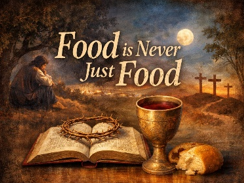
Food is never just food. Adam and Eve became bonded to death and sin when they ate the fruit. Abraham prepared a feast for three strangers and received no ordinary promise. The Israelites dined in homes with blood-soaked doorframes in preparation for deliverance. Food is never just food.
Near the end of his ministry, Jesus washed feet, broke bread, and served wine. It wasn’t just a meal—it was a covenant. But that night didn’t end at a table. After the hymns, Jesus prayed in a garden. During the meal he prayed over a cup; now he prays that the cup would pass from him. There are some cups that won’t “pass over.” There are some cups we must drink if we want to do the will of God. These are the hard things in life. Jesus does drink that cup. In that garden he prays the prayer that saves the world: “Not my will, but yours be done.” The cup was emptied on a Roman cross.
Silent Saturday gave way to Resurrection Sunday. The risen Savior appeared, and it only took a few encounters to see him imparting faith and restoring relationships. In resurrected form, Jesus continued to do what he did throughout his ministry: gather people around him for meals. Peter is restored during a beachside fish breakfast. The Emmaus Road disciples don’t recognize Jesus during Bible study—taught by Jesus himself—but they do recognize him when he hosts the meal and breaks the bread.
Food is never just food. Today, I pray you are hungry enough to feast: feast on actual food—Solomon highly recommends it. Feast on spiritual food—it’s commanded. And most importantly of all, sit at the table with the Host.
- Lance Havens
Silent Saturday
March 1
SILENCE……Initially peaceful, then uncomfortable, followed by anxiety—finally, a measure of peace. Once in a hundred times, it becomes a breakthrough.
I hiked 14 miles. I crossed the notch between two canyons and pleaded with God—for one teenager. Once I lay prostrate in a church building late at night alone, face down, asking God to heal a deep wound. When words fail, Romans 8 says the Holy Spirit groans on our behalf.
I’m a speech-language pathologist by training. I’m hyper-aware of the beauty and complexity of speech sounds. I’m amazed at how language can be precise and flexible. And yet, in spite of our elegant linguistic abilities, words fail us. Sometimes the only response is languageless, soundless, soul-worship… silence.
Jesus was the incarnate God-Man. He surrounded Himself with a circle of friends. They loved Him. They even said some of the right words: “You are the Messiah, the Son of God.” They held some of the right beliefs. But on Silent Saturday, they couldn’t mouth those words. They sat without glib answers. They sat with doubts.
I’m sympathetic to those disciples. Sometimes life is hard and we feel the pain of the crucifixion—we haven’t made it to the resurrection… yet. I like Silent Saturday. I like praying in the dark. I like praying for causes that require a miracle.
Sit in the dark. Pray for things big and small. Our annual Prayer Vigil is April 3–4. I invite you to share your requests. I invite you to step into an hour of silence. In that silence, don’t rush through the darkness; wait for the dawn. Sunday is coming!
- Lance Havens
Better Set of Troubles
February 22
Jesus tells us that in this world we will have trouble. I’m interested in having an increasingly better set of troubles—and by God’s goodness, I think that’s what we’re seeing.
Some gatherings can be noisy when we begin services, not because something is wrong, but because there are more people than we’ve had in the recent past. On Wednesdays, we don’t start the FLC class as quickly as we once did, because it takes longer to wrangle the kids. Some parts of the facility don’t always look as orderly as we’re used to, because the building is getting more use by more people for more gatherings. Many of the issues I’ve mentioned are tied to health and growth. We should celebrate these troubles. They are progress, not impediments.
My plan is to address these issues so we’re ready for the next set of challenges. My prayer is not for a problem-free congregation, but for a faithful church that loves God and loves people so well that God can trust us with the challenges that come from discipling people and growing in faith.
If the goal is problem elimination, the quickest path is for the frozen chosen to meet one hour a week in comfort: folded hands, total agreement, no transformation, no repentance, and no mission—until there are fewer and fewer of us. You and I reject that!
So together, we choose the messy way. We choose the noisy way. We reach out. We disciple. We love. We are—the church.
May we manage our blessings today and be ready for a whole new set of troubles tomorrow. Let’s do it together, faithfully. Let’s do it together until Jesus returns.
- Lance Havens
Jesus
February 15
My mind ponders and wanders. I enjoy ideas. I’m a bit like the Greeks on Mars Hill—curious. I love the process of learning, thinking, and teaching. This past week, along with Doug, I taught about the spiritual implications of artificial intelligence. I also began a study of early church history for a future class. Subjects like these give the mind plenty of room to roam.
Meanwhile in real life, I met with ministry leaders to discuss the practical functioning of our ministries. I’ve also worked on the logistics of merging Oasis with a youth rally—and serving cold-brewed coffee to attendees. And if those aren’t practical enough, we’ve been dealing with a plumbing issue at the building. As part of that, we even ordered “pipe-friendly” toilet paper. It doesn’t get more practical than toilet paper and plumbing!
So, to summarize: my mind has plumbed the depths of early church history, jumped ahead to consider faith in an AI-saturated world, and dealt with actual plumbing issues.
Cool story, Lance. What’s the point?
My point today is the only thing that should ever be the point: Jesus. He is at the center of all of it. Jesus guided the early church, so I care about the early church. I want our events, ministries, and infrastructure to function well so we can most glorify Jesus. He is before all things, and in him all things hold together. He is the Alpha and the Omega. He has no rival. He is worthy of our full allegiance.
May you revel in knowing Christ. May you be like him. May you make him known.
- Lance Havens
Oasis
February 8
We launched Oasis last week, and I hope heaven mirrors that day. We gathered to play and worship in the name of Jesus. I played basketball with five decades of men (teens through 50s). Women played Nertz with all the intensity of a NASCAR driver making a pass on the turn. I heard both the joyous eruption and the cries of anguish when the last spoon was snatched up. Men played 42—a game I’m convinced Texas men will still be playing when the trumpet resounds and Christ returns. Jyles lively led us in song, and Doug, as always, powerfully taught the Word while we sipped hot cocoa crafted by Waylon Klutts. It was a great day.
I don’t think these moments are accidental. I think we all carried an unstated need. Last week I wrote about the church’s retention problem with our own young people. One of the clearest themes in the research is that intentional intergenerational ministry is among the best strategies for long-term faith formation. You can use that kind of language if you want; I prefer to think of it as being an integrated family.
Oasis was special because it met a real need. God didn’t design us to share life only with people in our own age cohort. Don’t get me wrong—it’s a gift to walk alongside people in the same age and stage, and most of our lives and ministries already check that box. Oasis addresses a less-met need: sharing life across the generations.
The God of Abraham, Isaac, and Jacob is a generational God, with a plan that spans—and includes—all generations. I hope you’ll join us at 4:30. I hope you’ll make a new friend and find quenching beyond the refreshing lemonade.
- Lance Havens
Generational Faith
February 1
The local church is failing many of our young people. A commonly cited pattern is that roughly two-thirds of young people who were active in church as teens disengage within the next few years after high school. Some return later; many don’t.
Simply attending church as a child does not automatically produce “sticky faith” (to borrow the title of a major Fuller Youth Institute project). One of the consistent themes in that research is that siloed youth ministry and mere attendance—by themselves—do not reliably yield long-term discipleship. What helps is when teenagers are meaningfully connected to faithful adults across the whole church.
As they put it: “Teenagers also need to rub shoulders and build relationships with adults of all ages.” Another line is just as direct: “Young people appear to benefit from intergenerational activities and venues that remove the walls … separating the generations.” And this challenge is memorable: “Each young person is greatly benefited when surrounded by a team of five adults. We call this the new 5:1 ratio.”
This is a call especially for parents and grandparents. If you want your children—and someday your grandkids—raised in a Christian home, don’t let them only be known by their peers and their youth minister. Surround your child with faithful Christ-followers of all generations.
That’s why we’re launching Oasis, a 10-week Sunday night gathering designed to bring generations together. Bring a board game or wear basketball shoes. Come alone or invite friends. Sit and visit while others play, or jump into a game of dominoes. After open gym and fellowship, we’ll gather for worship and a brief devotional.
It won’t happen all at once and a 10,000 mile journey starts with one footstep, but we pray community is formed and faithfulness is practiced on a generational scale.
- Lance Havens
The Restoration Movement
January 18
The Restoration Movement didn’t begin with command, example, necessary inference (CENI) hermeneutics. The first generation of leaders were dabblers in those arguments. For the generation that followed, however, CENI became an animating force. This interpretive method grew closely tied to our identity. It made the grand promise of offering an “objective” way to read Scripture. The church would “speak where the Bible speaks and be silent where the Bible is silent.” We would restore “New Testament Christianity” and usher in a new epoch. Our numbers swelled. It worked.
But no tree grows to the sky. Reality hit. CENI fueled petty divisions over kitchens, classes, colleges, communion, and countless other issues. I’ve discussed those flaws previously.
CENI, noble in its intent, proved—like most human endeavors—to involve tradeoffs. Its emphasis on study and obedience is laudable. Yet its limitations became increasingly apparent. Today, our universities no longer teach it, and most ministers no longer preach it.
What’s next for the mainstream of our movement? Two sources have shaped my own study: John Mark Hicks and Tom Olbricht. Both reject cultural relativism and the abandonment of obedience. The paths they advocate will not lead to a “free-for-all” in the assembly. They do call us to place Christ at the center of our reading of Scripture, to respect authorial intent, to read the Bible as a unified story, and to engage it with theological depth that distinguishes between description and prescription.
No hermeneutic is perfect. The church of the future will look back on our time and see our flaws. In the end, we place our hope in the Logos—not in the way we conceptualize how to read the printed words.
- Lance Havens
The Restoration Movement
January 18
The Restoration Movement didn’t begin with command, example, necessary inference (CENI) hermeneutics. The first generation of leaders were dabblers in those arguments. For the generation that followed, however, CENI became an animating force. This interpretive method grew closely tied to our identity. It made the grand promise of offering an “objective” way to read Scripture. The church would “speak where the Bible speaks and be silent where the Bible is silent.” We would restore “New Testament Christianity” and usher in a new epoch. Our numbers swelled. It worked.
But no tree grows to the sky. Reality hit. CENI fueled petty divisions over kitchens, classes, colleges, communion, and countless other issues. I’ve discussed those flaws previously.
CENI, noble in its intent, proved—like most human endeavors—to involve tradeoffs. Its emphasis on study and obedience is laudable. Yet its limitations became increasingly apparent. Today, our universities no longer teach it, and most ministers no longer preach it.
What’s next for the mainstream of our movement? Two sources have shaped my own study: John Mark Hicks and Tom Olbricht. Both reject cultural relativism and the abandonment of obedience. The paths they advocate will not lead to a “free-for-all” in the assembly. They do call us to place Christ at the center of our reading of Scripture, to respect authorial intent, to read the Bible as a unified story, and to engage it with theological depth that distinguishes between description and prescription.
No hermeneutic is perfect. The church of the future will look back on our time and see our flaws. In the end, we place our hope in the Logos—not in the way we conceptualize how to read the printed words.
- Lance Havens
Hermeneutics, Again
January 11
Earlier, I praised the strengths of CENI (command, example, necessary inference). Today, I share my critiques of CENI as a centering hermeneutic.
1) It stresses church practices over transformation - Left unchecked, CENI sends adherents on a quest to perfect the local congregation using a blueprint never clearly presented in Scripture, while saying far less about discipleship and spiritual formation. My tribe taught me the prooftexts for a plurality of elders but did not teach me how to fast.
2) It elevates the epistles over the Gospels - I love Paul. But CENI gives outsized weight to Acts and the epistles. This sidelines Jesus’ teachings as the interpretive core.
3) It is inconsistently applied - Weekly communion and offerings are treated as binding patterns, while foot washing, the holy kiss, and warnings about gold and adornment are dismissed as “cultural.” One could argue that practices embraced by churches of Christ in the 1950s were deemed “authoritative,” while those we didn’t prefer were labeled “cultural”—and we’ve been locked in ever since.
4) It ignores authorial intent - Rules are often drawn selectively from incidental details (the one-cup communion debate comes to mind), rather than from what the author intended to teach.
5) It leads to division - “Necessary inferences” become tests of obedience, and churches fracture over kitchens and clapping. CENI flattens the text, obscures the contours of importance, and sacrifices the Golden Rule and the unity of the body over lesser issues.
No hermeneutic is perfect but understanding how we read can help us speak more gently, listen more patiently, and remain united as we seek not a pattern, but Christ.
- Lance Havens
BIBLE STUDY
January 4
I’ve previously described several hermeneutical tools used within churches of Christ. I’ve intentionally saved CENI (command, example, and necessary inference) for last. It is the principle most closely associated with our movement, yet it has been steadily declining—first at the university level and now in schools of preaching. It is rarely emphasized in pulpits today, though it still has a stronghold among older members who were taught by ministers trained between the 1930s and 1960s.
The roots of CENI extend back to Zwingli and the Reformation of the 1500s, and more directly to the Enlightenment and Scottish Common Sense Realism. The Campbells (Thomas and Alexander) held a more nuanced view of CENI than many assume. Thomas was openly cautious about making deductions binding, and Alexander leaned more toward grammatico-historical principles. He occasionally used CENI-style arguments in debates, but not in his more substantial writings. It was later leaders who hardened CENI into a formalized hermeneutic.
CENI has been a blessing in many ways. It has upheld the centrality of Scripture over human traditions. It has called us to close, careful reading. It has placed a rightful emphasis on obedience. I’m grateful for this fruit. However, an unguarded strength becomes a double weakness, and CENI has its share of weaknesses as a primary hermeneutic. I’ll discuss those later.
If you have stayed with me this long, thank you. I know these are not typical bulletin articles, and some may be taken aback by this kind of discussion. Just know that we interpret Scripture from the foot of the cross—not from fear, not from tradition, not from pressure, but from the love of Christ, who draws us to himself.
- Lance Havens
IMMANUEL
December 28
In the 1950s, psychologist Harry Harlow studied how attachment forms. Infant monkeys were given two surrogate “mothers”: one made of wire, and one wrapped in soft cloth. Though both offered nourishment, the infants consistently clung to the cloth mother. When frightened, those with warmth and comfort found security; those with only provision withdrew in distress and suffered. Harlow concluded that attachment requires more than proximity—it requires warmth, approachability, and presence.
That insight helps us see the beauty of the Christmas story. In Luke 2, shepherds are terrified by the appearance of angels announcing Jesus’ birth. Yet they are drawn not to the spectacle, but to the child—lying quietly in a manger. The angel was glorious, but unapproachable. Jesus was vulnerable, near, and able to be held. The angel was a messenger; Jesus was the Message.
Christmas is beautiful not because of gifts, decorations, or even angels, but because God chose closeness. Rather than shouting instructions from heaven, God came near. In Jesus, God bonded Himself to humanity—walking with people, touching the untouchable, and sharing life with those He loved.
Faith can easily become mechanical—a checklist of songs, prayers, and routines. But Christianity is not built on boxes checked; it is built on attachment to a Person. We gather not to perform a sequence, but to center our lives on Jesus.
The gospel is an invitation to attachment—to Jesus, and through Him, to one another. Christmas reminds us that God came close—and He still does.
- Lance Havens
HERMENEUTIC PRICIPLES
December 14
I have been describing the three major hermeneutic principles associated with Churches of Christ. The one most historically associated with our movement is CENI (command, example, and necessary inference). However, beginning in the 1970s and continuing through the 1990s, the Grammatico-Historical Method became mainstream in Churches of Christ. Today it is the dominant academic and ministerial hermeneutic. It has even supplanted CENI as the primary approach at at least one of our schools of preaching. So, in a sense—if not fully today, then certainly in the near future—the Grammatico-Historical Method is the dominant hermeneutic of our movement. I realize this may come as a surprise to some of you.
Now allow me to explain the Grammatico-Historical Method. This approach pays close attention to grammar, vocabulary, literary form, historical context, and authorial intent. The most important takeaway is the emphasis on authorial intent. Interpretation must begin with what the author intended the original audience to understand. This method discourages proof-texting, eisegesis, and other imprecise reading practices. It is also why many preachers today are encouraged to present expository sermons rather than the topical sermons you may remember from the past.
Many conflicts within the church revolve around well-meaning Christians who do not realize they are reading the same text through different lenses. One person may be using necessary inference with the goal of restoring New Testament Christianity, while another is employing a hermeneutic not rooted in pattern theology but instead grounded in the whole of Scripture and its context. The first may quickly cite isolated texts, while the second points to broader teachings (and sometimes to tensions within the proof-texts themselves).
Regardless of the lens we use, the Scriptures remain God’s gift to us—revealing His character, explaining the human condition, offering hope for all generations, and ultimately pointing us to and glorifying Jesus Christ.
- Lance Havens
HERMENEUTICS
December 7
Previously, I mentioned the three primary hermeneutical approaches historically used in churches of Christ. Today, I will discuss perhaps the least emphasized of the three—Tripartite Dispensationalism. The result of this approach often feels like a fish in water: the fish simply takes the water for granted. Yet earlier in our history, this framework was not so obvious and even contributed to fractures within the Stone-Campbell Movement.
Tripartite Dispensationalism views Scripture through the lens of eras—typically the Patriarchal Era, the Mosaic Era, and the Christian Era. For example, Christians today may eat pork, while God’s people in earlier eras were forbidden to do so. We also no longer practice temple sacrifices or observe the Sabbath as a matter of binding law. Once, when I explained this approach to a friend, he responded, “So you don’t believe in the Old Testament?” I clarified that the Old Testament is fully “Scripture,” but its laws are not binding on Christians as covenantal authority.
This seems obvious to many of us today. However, in 1816, Alexander Campbell was teaching among “Separate Baptist” congregations—groups that shared much common ground with the early Restoration Movement. Campbell affirmed the divine origin of the Old Testament but denied the binding authority of its commands and examples, declaring them “fulfilled.” This disagreement caused a significant fracture between the groups.
So what’s the point? We stand on the shoulders of giants. Not every generation must re-fight the same interpretive battles. Paul tells us in Ephesians 3 that the “mystery of Christ” has been made known to people of other generations—the mystery of how God grafts together Jew and Gentile, calling people of every tongue, tribe, and nation into unity under the headship of Christ.
- Lance Havens
HOW TO THINK ABOUT THE BIBLE
November 23
Last week I pointed out that people have been thinking about how to think about the Bible almost as long as Scripture itself has existed. Today I want to introduce a few technical words that describe how we read and interpret the text.
The first word is exegesis. It literally means “to draw out” and refers to discovering the author’s intended meaning. The Anchor Yale Bible Dictionary puts it this way: the goal of exegesis is “to know neither less nor more than the information actually contained in the passage.”
Its evil twin is eisegesis. Eisegesis occurs when we strip a passage of its context and authorial intent and replace it with our own meaning. Matthew 18:20 (“where two or three are gathered…”) and Jeremiah 29:11 (“I know the plans I have for you…”) are familiar examples of verses often pulled out of context.
The modern reader is charged with coming under the authority of Scripture’s clear teaching—but doing so requires interpretation.
Exegesis is one tool within the broader field of hermeneutics, which refers to the lens or method by which Scripture is interpreted. Historically, within Churches of Christ, three primary hermeneutical approaches have been used:
1.Grammatico-Historical – emphasizing authorial intent and the original audience.
2.Tripartite Dispensationalism – distinguishing between God’s dealings with Jews, Gentiles, and the Church.
3.CENI: Command, Example, and Necessary Inference – the approach most closely associated with what is known as pattern theology.
You may wonder why this discussion matters. It’s a fair question. Loving God and loving others is our highest calling—and reading Scripture well is one of the primary spiritual disciplines that shapes us for that mission.
- Lance Havens
BIBLE STUDY IS HARD
November 16
Bible study is hard. Time, language, and culture are obvious obstacles to a clear reading of Scripture. But in my experience, my expectations and presuppositions can be even more damaging, because they’re less obvious.
Jewish scholars have reflected on how to read Scripture for centuries. In Christianity, the New Testament is “theology on the go,” written in the midst of ministry. Early Christian leaders identified which writings were canon and composed the creeds as bulwarks against heresy, wrestling with questions of authority and orthodoxy.
All of this leads to one point: as long as there has been a sacred text, there have been followers grappling with how to think about that text. Whether it’s the Mishnah and the Talmud or the Apostles’ Creed and later theology, the Bible can be read simply—but not simplistically.
In some ways, it is easier to say what the Bible is not. It is not a book of spells, though its words are living and active. It is not a magic eight ball or a fortune teller, though it answers our most important questions and reveals how history culminates. It is not a rulebook, though it teaches us how to live.
So we struggle on, as generations have before us. In these pages we discover ourselves (we are darker than we think). We discover our purpose (it’s better than we think). And we discover God and His love for us (it is greater than we can imagine).
In December we will begin a study on the Gospel of John in our Sunday morning Bible classes. Make plans to join us and be transformed by the Word.
- Lance Havens
POLARITY
November 2
Some parts of faith are simple. There are black-and-white issues in life. The Ten Commandments come to mind. There’s little disagreement among Christians about what is clearly God’s best. We may struggle with how to apply those truths in particular situations, but we generally know the “right answer.”
Then there are more nuanced matters. I’ve encouraged people to hold two ideas at the same time, describing Christianity as a two-handed faith. In one hand we hold the mercy of God; in the other, we rightly recognize Him as a just judge.
This week I learned there’s a single, elegant word for that tension between two good things: polarity. Pairs like grace and works, truth and love, faith and reason, and justice and mercy aren’t problems to solve—they’re complements to balance. In my experience, most disagreements among believers come down to where to place the fulcrum. That’s understandable. But to grow, we first have to admit that a fulcrum exists—and that probably no one knows exactly where it belongs.
That truth should actually comfort us. It means there’s no formula for every situation. Even if we found balance once, the ground may have shifted—so the fulcrum might need to move again.
Luke was a “fulcrum guy.” Ben Siburt notes that Luke places the Parable of the Good Samaritan (service) right beside the story of Mary and Martha (devotion). Luke doesn’t ask us to pick one. He invites us to live in the tension of both service and devotion.
Recognize tension between good things. Know the season. And with both hands, hold tightly to the faith that lives in holy balance.
- Lance Havens
DIVORCE CARE
October 19, 2025
DivorceCare begins November 5 in the Hope Classroom at 6:30 p.m. Call/text/email Chuck Morris at 210-573-5083 or chuck5614@gmail.com. See below for more details.
Separation and divorce, no matter how amiable, are among life's most painful experiences. A DivorceCare group offers a safe, welcoming space where people truly understand the difficult emotions and unique challenges of this time.
This 13-week support program is designed to help you navigate your personal healing journey. Because separation and divorce are often messy and confusing, the group provides helpful ways of coping with challenges, managing new relationships, and gaining solid support every step of the way.
At each weekly meeting, you will first view a video featuring respected counselors, ministers, and healthcare professionals who discuss crucial divorce and recovery topics, alongside relatable personal stories. This is followed by a small group discussion, allowing time to talk, share support, and personally apply the lessons learned. Each participant receives a workbook filled with valuable exercises to navigate their road to recovery.
Key topics covered include how to manage powerful divorce-related emotions like loneliness, anxiety, bitterness, anger, and grief; how to cope with major life changes; the importance of forgiveness; and practical advice on navigating legal and financial issues.
Whether you are in the early stages of separation or struggling with the painful aftermath, this is an important opportunity to be around people who understand exactly what you are feeling.
If you are walking through separation or divorce, we warmly invite you to attend.
For more details, and to find and register for our group, please visit https://www.divorcecare.org/leaderzone/my/groups/277278.
You are welcome to just show up without registering.
-Chuck Morris
MISSIONS
October 12, 2025
As I am writing this, I am in New Mexico and have spent several days with the brothers and sisters of many of the Navajo churches of Christ. The Whiddens and Purschs are on our second trip to the Navajo Nation reservation in New Mexico and Arizona. Our hearts have been touched by the pleas of our brothers and sisters here.
There are several common pleas/needs that we have encountered on both trips here. First, they need couples capable of teaching and preaching to “spell” the primary workers of the congregations so that they can decompress and also be fed themselves. The second request is leadership training and development. We are in the process of developing a solution to this problem. We will share this with the congregation in the near future.
The third need is monetary assistance to keep the utilities on in the church buildings. The congregations on the reservation are very poor and it often falls to one or two members to absorb the costs of the utilities, but it is very difficult due to the general poverty level on the reservation.
Can you help by giving two weeks to a month to spend with a congregation on the reservation to teach and encourage the Christians there? Can you teach a course on spiritual leadership or personal evangelism? Contact one of the members of the missions committee if you are interested in either of these efforts.
-Clay Whidden
WORSHIP WITHOUT WALLS
October 5, 2025
I’ve always felt renewed by the outdoors—whether on mountain trails, quiet parks, or even in my own backyard. The beauty of creation lifts my spirit and fills my heart. That sense of vitality is why I’m so grateful for Worship Without Walls: a day for us to step outside the church building and encounter God together under the open sky.
This special service reminds us that worship is not confined to four walls. The God who created mountains, rivers, and trees also designed us to thrive in His presence, wherever we gather. Worship Without Walls gives us a chance to breathe deeply, look around at one another, and be encouraged as we sing, pray, and share life in Christ.
When & Where
- Sunday, October 26th – No gathering at the AACC building
- Meet at the Brownwood Event Center (601 E. Baker St.)
- Worship begins at 10:30 AM – no Bible classes that morning
What to Expect
- A beautiful downtown setting with shade and comfortable seating
- Golf carts available for anyone who needs assistance
- After worship: pulled pork sandwiches and games on the lawn
This will be our second year at the Event Center, and it has quickly become a highlight of our fall calendar. It’s a day of joy, fellowship, and renewal. Please make plans to join us, invite a friend, and let this time of worship refresh your soul like streams of living water.
-Lance Havens
MISSIONS
September 28, 2025
How do you measure success? Numbers are a normal way to measure how successful we are in
different areas of life: money, degrees, cars. It’s easy to measure “spiritual” success the same
way: baptisms, attendance, offering.
When it comes to the Great Commission, it’s easy to do the same thing. But the truth is that it is
all about people. Yes, a lot goes on: Bible studies, service programs, building projects, retreats.
But in the end, it is all about people. It’s exciting to see how God changes people. Without
minimizing the huge spiritual changes He makes in all of us, it is so wonderful to see the changes
He makes giving people purpose and bringing dignity to their lives.
Ronaldo is 28 years old. We met him, his Mom and his younger sister 2007. They were very
poor! They lived in a 1 room house made of adobe with no running water. That had been their
past and their future didn’t look much better. That same year Agustina became a Christian,
followed by Ronaldo and Leslie. Little by little, we saw God in action. He began working
through the local church, improving their living conditions, their health and work opportunities.
In 2014 Ronaldo made the decision to do something extraordinary for someone in his
environment: go to college. He was accepted into one of the country’s best universities and
graduated with a degree in Agricultural Engineering.
Ronaldo’s life is one of the ways I measure success in missions. He is a faithful Christian man
who always wants to do what is right in God’s eyes, help provide for his Mom and live a life
worthy of the dignity Jesus brought to it.
-Butch Sandoval
A GOOD PROBLEM
September 21, 2025
In April, we upgraded our auditorium seating. For years our attendance averaged around 300, but our pews seated over 900. That meant we were used to worshiping at only 30% capacity. Conventional wisdom says churches thrive when capacity is between 60% and 80%. We were far outside that range—and felt the consequences.
Through the Faith Driven Campaign, we removed the pews and installed chairs. With the same 300 average attendance, we were now at 60% capacity. It felt right. Our already strong singing was enhanced, and the fuller room carried more energy.
Then God began blessing us with growth. Attendance started climbing. Last Sunday, with 348 in worship, we were about 70% full (subtracting the first row). That puts us squarely in the “sweet spot” of 60%–80%.
Still, old habits linger. Many of us like to spread out, and it’s tempting to think the answer is more chairs. But I believe the answer is attentiveness—and an opportunity to show love.
Last week, some guests arrived late and struggled to find seats together. If you consider yourself a mature Christ-follower, I have a simple request: open your eyes. Watch for new faces—or familiar ones—looking for several seats. They may feel awkward or embarrassed.
Solve the problem. Wave them over. Slide down. Ask others you know to scoot closer. It’s a small act, but you never know the ripple effect of such awareness and kindness.
The New Testament is full of moments where large crowds made space—and that’s when the miracle happened. Think of Zacchaeus climbing the tree. Remember the paralyzed man lowered through the roof. Picture the bleeding woman pressing through the crowd. When room is made, lives are changed. Make room—you never know what miracle God may do.
-Lance Havens
OVERCOME EVIL
September 14, 2025
When evil cannot debate, it shames. When evil cannot reason, it silences. When evil encounters good, it kills.
We have entered an era of political violence. President Trump was struck by a would-be assassin’s bullet. Charlie Kirk was murdered in a targeted political assassination. These are unmitigated acts of evil.
Stephen spoke the truth. Filled with bloodlust, the religious leaders plugged their ears and rushed at him. Jesus spoke the truth. No one could stand against him either, so he was crucified.
A theme of my ministry is this question: How should we live? In light of recent acts of evil, I am reminded of two things.
First, we are redeemed by the Prince of Peace. Christians must remain committed to non-violence. Charlie Kirk’s persona was marked not by one microphone, but two. His career was built on conversation. He listened. He spoke. He debated. When his opponents could not defeat him in debate they turned to violence. As Christians, we must keep having conversations with those we disagree with—on a variety of topics. More talk. Zero tolerance for violence.
Second, Charlie spoke the name of Jesus at virtually every opportunity. He loved Jesus. He loved telling others about Jesus. He was never bashful about inviting Jesus into every area of public life. Speak the name.
As we mourn, let us not retreat in fear or lash out in anger. May we do what followers of Jesus have always done—stand firm in truth, walk faithfully in peace, and speak boldly in love. Evil may strike with shame, silence, or even death, but it cannot extinguish the light of Christ. Jesus is the Resurrection. He is the Way. In Him is Eternal Life.
-Lance Havens
LIFE GROUPS
September 7, 2025
Inertia is the pull to stay where you are when God is calling you forward. It’s Gideon’s fleece. It’s Moses’ objection. It’s Paul kicking against the goads. For us inertia is very likely the desire for a nap on the couch and our own carefully curated list of streaming options and football games. Inertia can be the invisible chains stifling sanctification and suffocating growth.
Inertia whispers that faith can flourish without fellowship and that intimacy with God can be had without inflicting the flesh. That simply isn’t true. Today, I invite you to strike a blow against the status quo championed by inertia. Step into a rhythm that is either new to you or is simply recapturing a passion you once held.
This is a season of momentum at Austin Avenue. This week we had what is likely the largest crowd for a midweek service since the pandemic. If you aren’t a midweek attender, show up. If you are a midweek attender we need more helpers, cleaners, and servers.
The new Sunday AM bible class quarter started today. Compared to norms, we have really large class attendance. But 40% of you still don’t attend a bible class. Find a class. The majority of our congregation is not wrong in finding value in our classes.
Life Groups launch today, sign up. It is roughly two months of talking about Jesus with other people trying to emulate him. Join.
We are in a good place. Don’t miss it. Don’t stay the same while others grow. Don’t sit it out while others sweat it out.
-Lance Havens
MISSIONS
August 31, 2025
When is the best time to plant a tree? Twenty years ago. When’s the next best time? Today. We all know that we plant seeds in the mission of God’s plan. Matthew 13’s Parable of the Sower tells the tale of seeds that fall on the path, or into the rocks and thorns. But wait, there is always good soil.
There are many plantings that don’t find good soil. But when you do, oh what the Lord will do. Twenty years ago, this congregation planted the seed of God’s word in the Bolivian city of Cochabamba. Twenty years later, this metro area has four churches praising God, with a fifth one being planted in the next year. Souls have been saved. Lives have been changed. A terrible bus accident – three young lives lost but the church persevered and trusted in God. Austin Avenue families have visited. AIM students have served. Missionaries have come and gone. Families have been fed. Youth groups have evangelized.
The first person baptized is now a missionary in Brazil. Elders have been named at Cochabamba Centro Church of Christ. Local Bolivians have graduated from the Monterrey School of Preaching. Songs of Praise have been raised up by over 200 where there were none. All by the grace of God. All by the action of this congregation. All because good soil exists. All because it’s the best time to plant a tree.
-Rodney Chesser
A BETTER YES
August 24, 2025
One of my favorite teachings is the idea of finding a “big yes” in life. Tim Elmore puts it well: “You can do almost anything, but you can’t do everything.” Hebrews encourages us to “run the race set before us.” It’s all the same idea.
We are surrounded by ministry opportunities, both locally and globally. Our church is abundantly blessed and able to serve in many of them. But here’s the truth: with God’s blessing we can do anything—but we can’t do everything.
When I hike, I can’t climb two peaks at the same time. In the same way, churches often preach about sacrificing the bad for the good, but we rarely admit that even good things must sometimes be sacrificed for the better things that God uniquely calls us to do.
One lesson of the Incarnation is that even Christ embraced human limitations. In John 12, when the Greeks asked to see him, Jesus didn’t say “no” outright. Instead, he stated his mission: to give his life for all people. His implicit “no” led to a greater “yes”: he would be “lifted up,” drawing all people to himself.
Jesus was mature enough to say “no” to a very good thing because God had given him a better “yes.” In doing so, the “no” itself became a “yes.” He was lifted up—and spiritually speaking, those seeking Greeks got their “yes.” They saw Jesus.
Here’s the point: not even Jesus did every good thing before him. He did what the Father laid out for him and trusted it was sufficient.
Today, ask God to show you what he has laid out for you. What is the “big yes” God is calling you to? He won’t call you to everything, but he will call you to what matters most.
-Lance Havens
BORROWING WORSHIP
August 17, 2025
Can you borrow the intangible? Can you give away what was never yours to keep? The answer is yes—it happens every Sunday. Language, ideas, words, texts, connections: these are my native tongue. Singing—choruses, shape-notes? Not so much. And yet every week I borrow those gifts from you. I’m swept up in your harmonies; my soul soars on your melodies—even though I couldn’t tell the difference between the two. Those shape-notes might as well be hieroglyphs to me.
Yet week after week you share a gift that was never yours to keep—a gift realized only in the giving: praise. All worship is rightly directed toward God—a pleasing aroma in the throne room, a veritable feast. Within that feast are crumbs; like a grateful beggar, I’m overjoyed just to be at the table—even if most of my vocal offerings are only the scraps I’ve gleaned from you.
Last week, Chad wrote about incorporating microphones into our worship service. To be clear, this is nothing new at Austin Avenue. The singers will remain seated in the pews; the only difference is that those holding microphones are committing to greater preparation and intentionality.
Here’s the paradox: the microphones aren’t for the gifted singers—though they may hold them. They’re for people like me—people who struggle to know and sing “their part.” I can devote more praise to God when I can clearly hear a model of the part I’m trying to sing.
So thank you—for lending what can’t be owned, for proclaiming what I cannot sing (well), and for sharing such a special moment with me and my family each week.
-Lance Havens
WORSHIP TEAM
August 10, 2025
Leading worship is a heavy responsibility. A worship leader must select the right songs that set the right mood, energy, and message and allows a large group of people to worship God in varying stages of life. Each week, a worship leader is an emcee, a conductor, a volunteer coordinator, and an event planner. There is a lot that goes through a worship leader’s mind during the service and during a song. We strive to give our best so that focus can be directed towards God and not our individual shortcomings.
The elders have decided to evaluate a Worship Team to assist the worship leader on Sunday mornings. This would be four singers on microphones – soprano, alto, tenor, and bass – who will compliment the worship leader and encourage the body to sing and worship with all their heart, mind, soul, and strength.
If you have a passion for singing and would like to participate in the Worship Team, please come join us each Wednesday night after class, starting August 13, in the auditorium. Each night we will practice upcoming worship songs, explore new songs, and begin planning the Worship Team introduction into our Sunday services. We also invite our sound and computer teams to join us in this process, ensuring we create an effective Worship Team that enhances, rather than replaces, our congregational singing.
If you are unsure and want more information, join us on Wednesday night and let’s learn together how we can best serve Austin Avenue in this way.
-Chad Benton